Password
Case study
FedEx
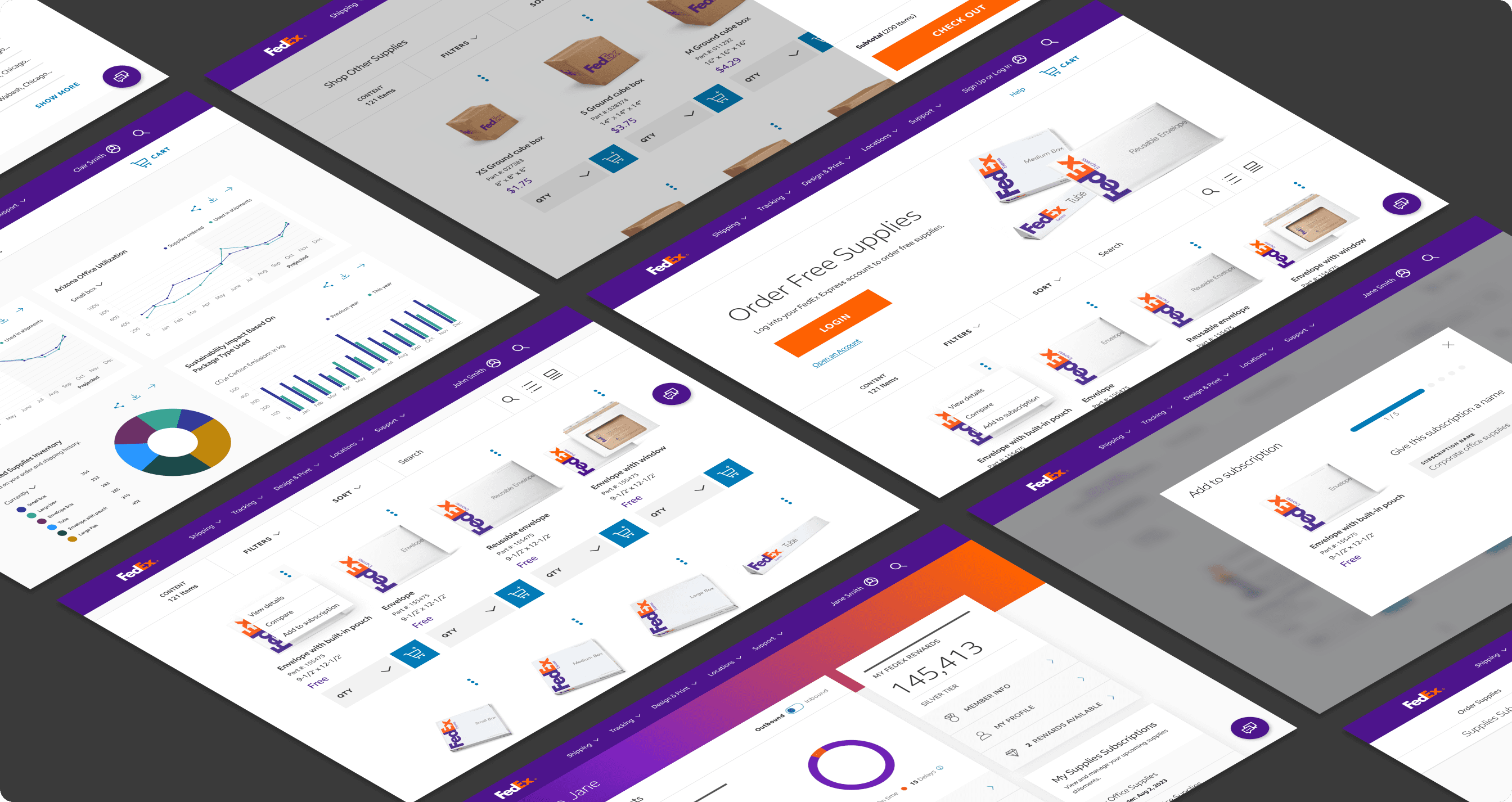
A future-state supplies experience that gives FedEx customers what an ordering page can't: a way to plan, not just react.
Role
Lead designer
Scope
Research, strategy, and future-state design across three phases
Domain
Shipping and logistics, enterprise SMB
Context
IA Collaborative for FedEx
Mapping the system
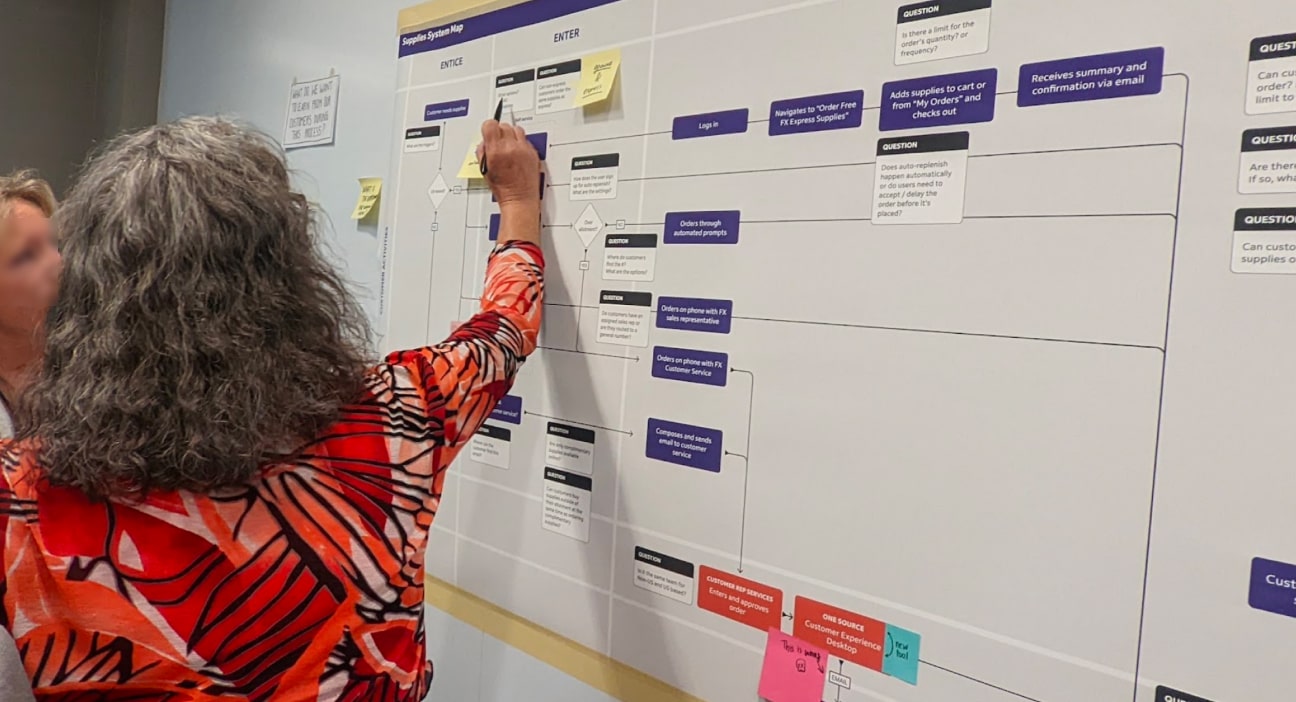
I started by mapping supplies as it actually worked at FedEx today. Over the discovery phase, I worked across nine internal teams and spoke with more than forty stakeholders to build a single source of truth: a system map that traced how a box request flowed from a customer's hand through warehouses, sales reps, customer service, account limits, and back out as a delivery.

A few things became clear quickly.
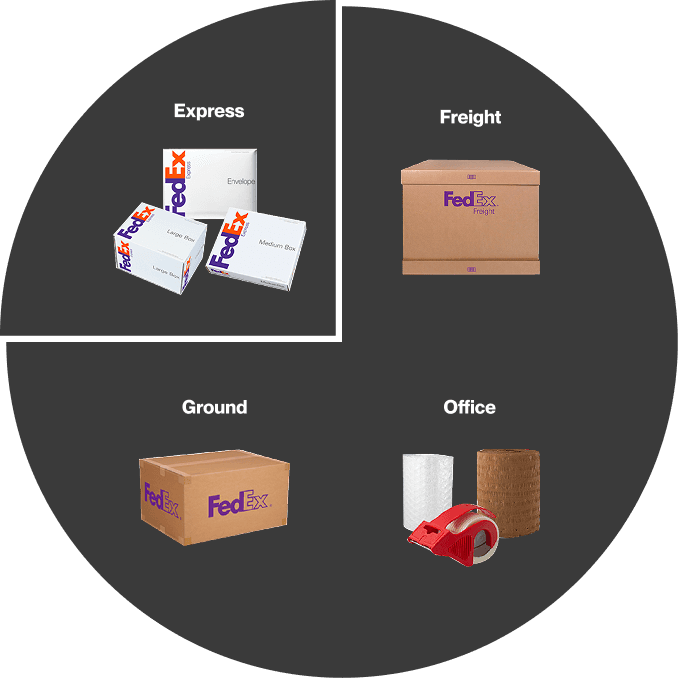
The first was that supplies was a confused category internally. At FedEx, complimentary supplies meant Express boxes and envelopes. To customers, supplies meant everything they needed to ship a package: Express boxes, Ground boxes, Freight crates, tape, peanuts, padded mailers, labels. Customers did not separate these by service line. FedEx did, and that mismatch was the source of half the friction.
The second was that supplies was treated as the small, trivial tail end of shipping. It got attention only when something broke: a customer ran out, ordered the wrong box, hit an account limit they didn't understand. And when it broke, the costs were not small. Late orders meant paying for expedited shipping. Wrong-fit boxes meant damaged product. Over-allotment holds meant entire shipments waited.
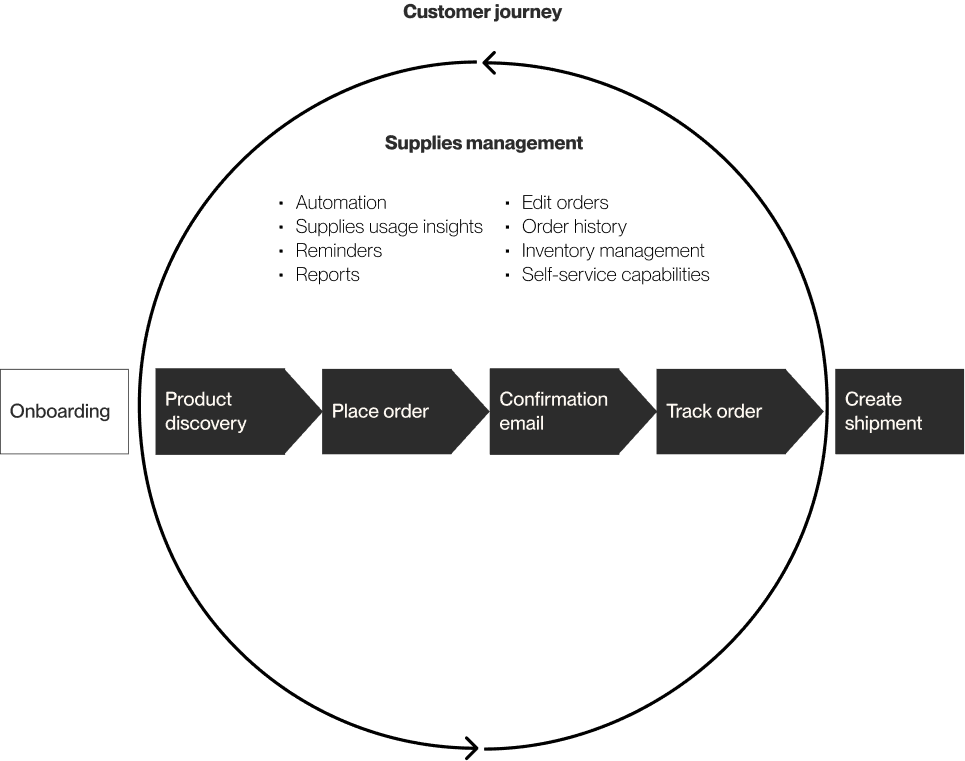
Treating supplies as an afterthought was expensive. We just hadn't done the work to see it yet.
Supplies wasn't a transaction problem. It was a planning problem that had been mislabeled as a transaction problem for years.
Talking to customers
With a map of the internal system, we went to customers. Eleven participants, recruited across small, medium, and large businesses, and across three shipping-frequency tiers: infrequent, frequent, and high-volume. The lightest shippers were sending under forty packages a month. The heaviest were sending over fifteen thousand.
Each session followed the same structure:
An ecosystem tour, where participants walked us through how they actually managed supplies today, including the tools, tabs, spreadsheets, and sticky notes.
A find-a-product task, where they completed a real ordering job on FedEx.com and narrated their way through it.
A concept evaluation, where they reviewed twelve future-looking concepts and ranked them by value.
The patterns were consistent across business sizes. The ordering experience itself was a secondary problem. The primary problem was that nobody had a real handle on what they had, what they were going to need, or when they were going to need it.
The the issue is is like our work is very unpredictable…and we’re kind of managing that week to week, or just by visual being like, ‘Oh, this looks low. Should order some.’ It should probably be tracked better, but we do what we can.
The reframe
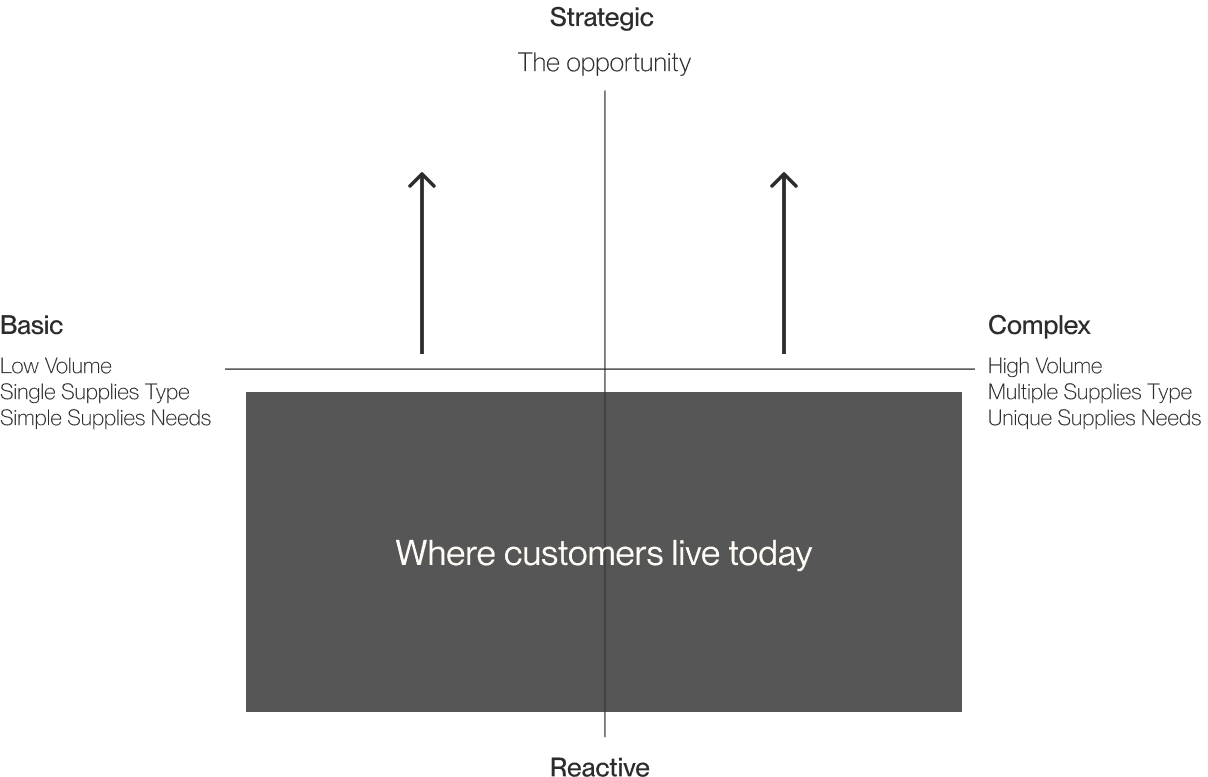
When we synthesized the research, we kept ending up at the same axis. Customers had supplies needs that ranged from basic to complex: low volume, single product type, simple needs on one end; high volume, many products, unique requirements on the other. That axis was the one FedEx was already designing for. Make the form easier. Make search better. Make checkout cleaner.
But the more useful axis was the one running perpendicular to it. Customers were not just basic or complex. They were also reactive or strategic. Reactive meant ordering when you ran out. Strategic meant ordering based on a forecast of what your business was going to need, factoring in seasonality, allotments, and surplus buffers.
Almost every customer we spoke to lived in the reactive half. Not because they lacked discipline. Because nothing in the experience invited them to live anywhere else.
That reframe became the thesis of the project. The opportunity was not a better ordering experience. The opportunity was moving customers up the strategic axis, by serving them data-driven recommendations, forecasts, and planning tools at the moments where reactivity was costing them most.
Supplies wasn't a transaction problem. It was a planning problem that had been mislabeled as a transaction problem for years.
Three principles
The reframe gave the project a thesis. Three principles gave us a way to design against it.
The vision in practice
With the principles set, the work moved into the future scenarios that became the project's deliverable. Three sequences below show what the strategic shift looked like on screen. Each anchors to one of the principles.
Sequence 1: Proactive planning
The clearest test of the reframe was a sequence where FedEx noticed a customer's shipping volume trending up over twelve months and recommended a subscription adjustment ahead of demand. The customer reviewed, confirmed or skipped, and stayed in control. Reactive to strategic in four screens.
01 — Subscription setup
Planning enters the experience. The system seeds a starting subscription based on history.
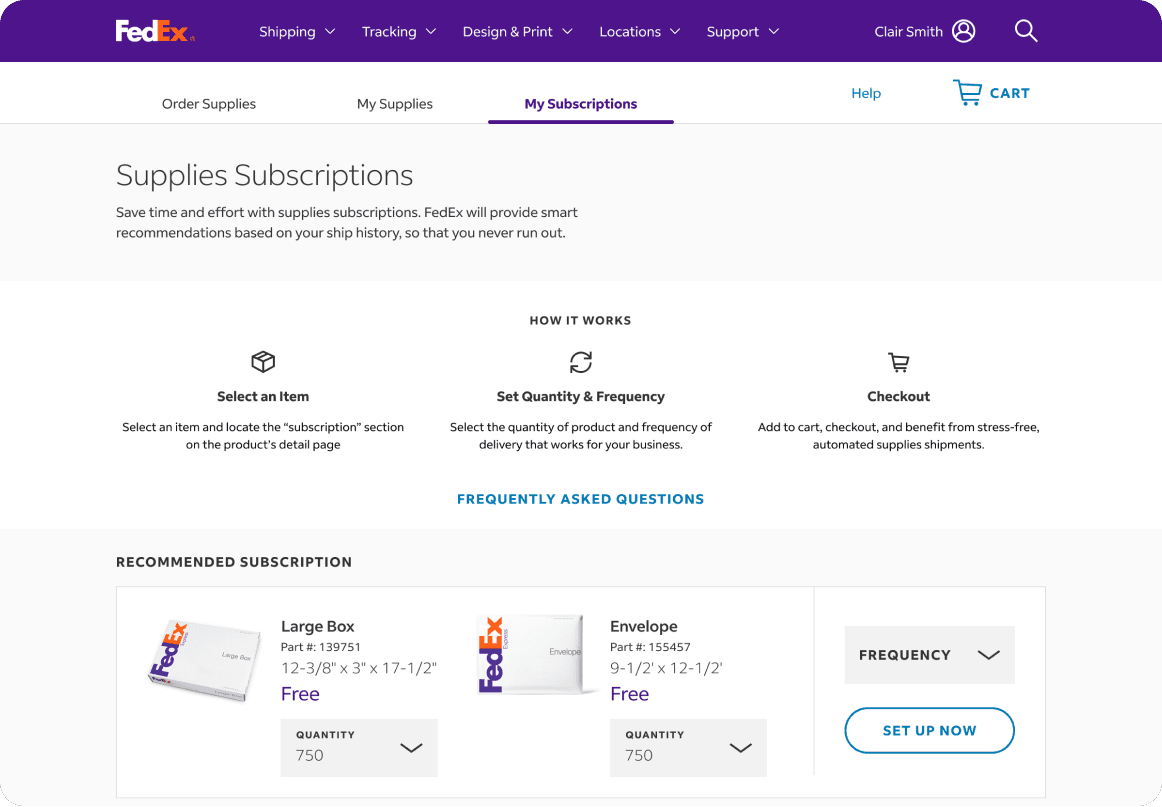
My Subscriptions page. How-it-works strip showing Select an Item, Set Quantity and Frequency, Checkout. Recommended Subscription card below with two products and a Set Up Now CTA.
02 — Prediction-based recommendation
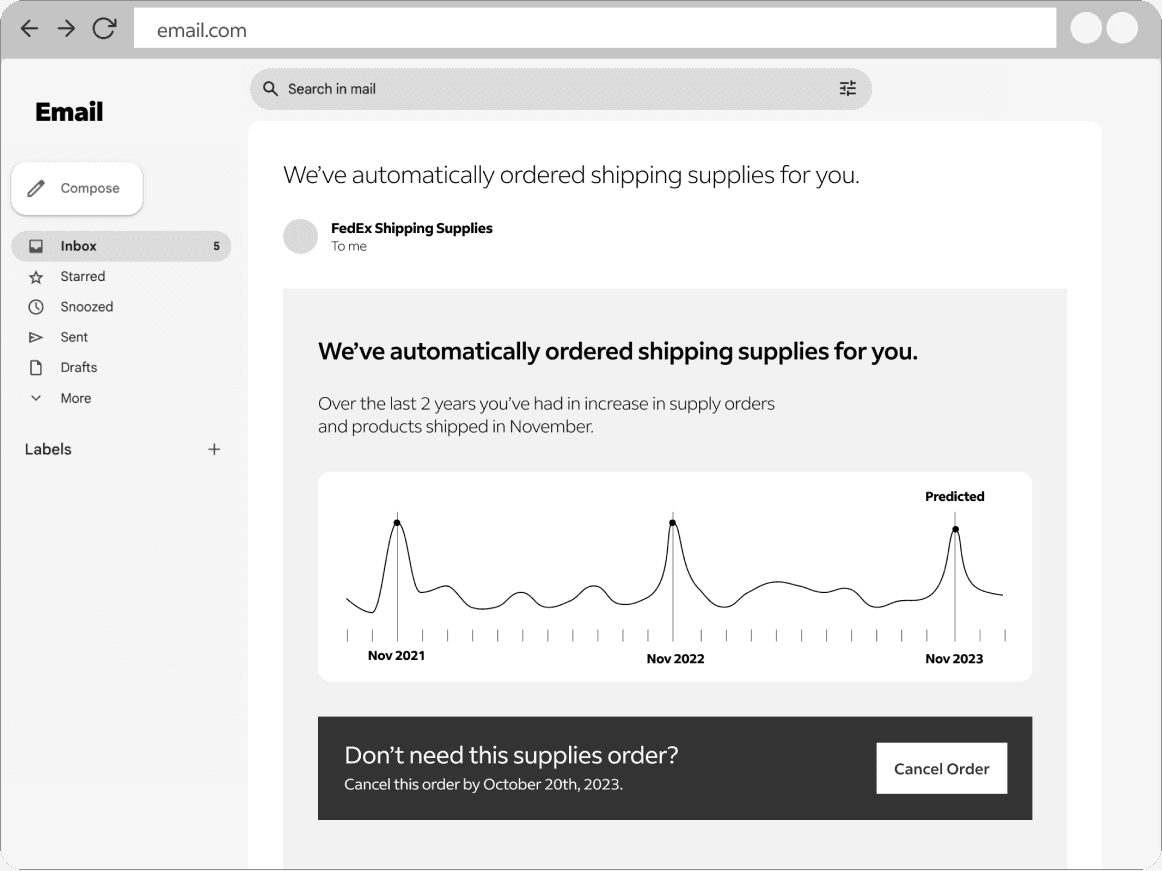
Year-over-year forecasting surfaced at the moment it matters, in plain language.
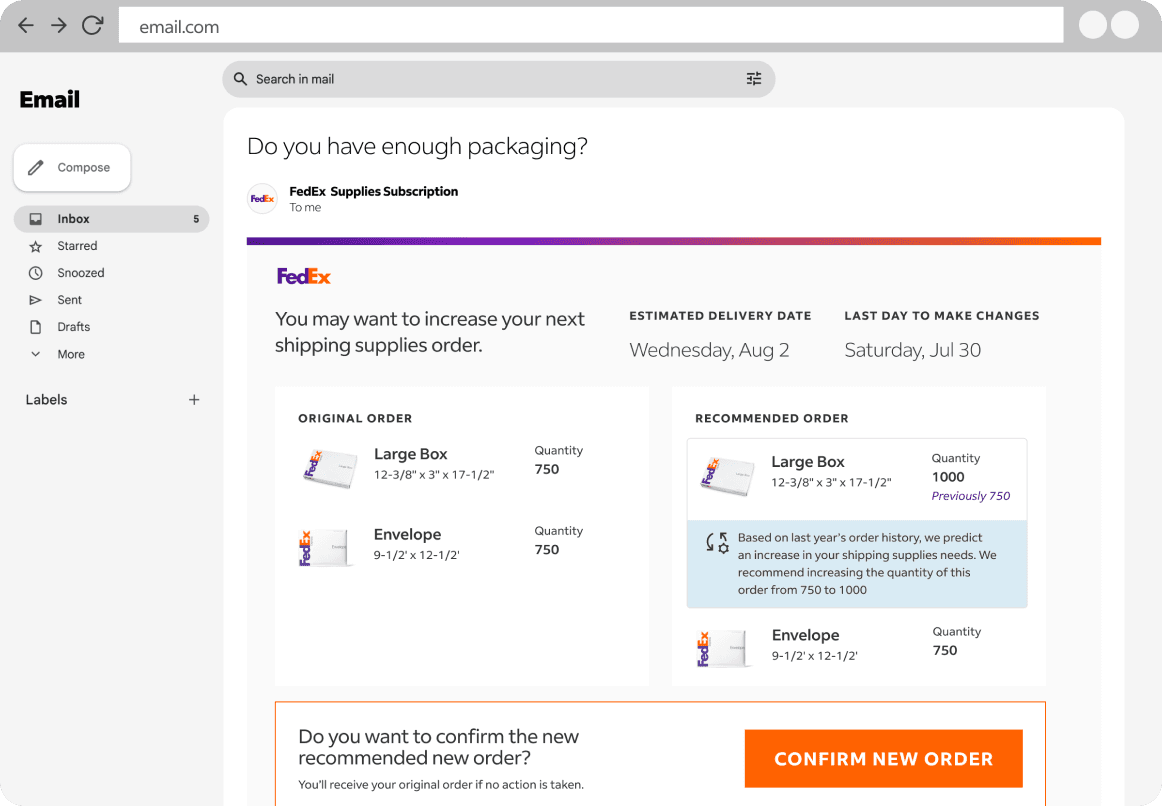
Email view. Original order and recommended order shown side by side, one line item adjusted upward. Inline explanation: "Based on last year's order history, we predict an increase in your shipping supplies needs." Confirm New Order CTA.
03 — Subscription, intelligently updated
After confirmation, the change is shown in context with the reasoning preserved.
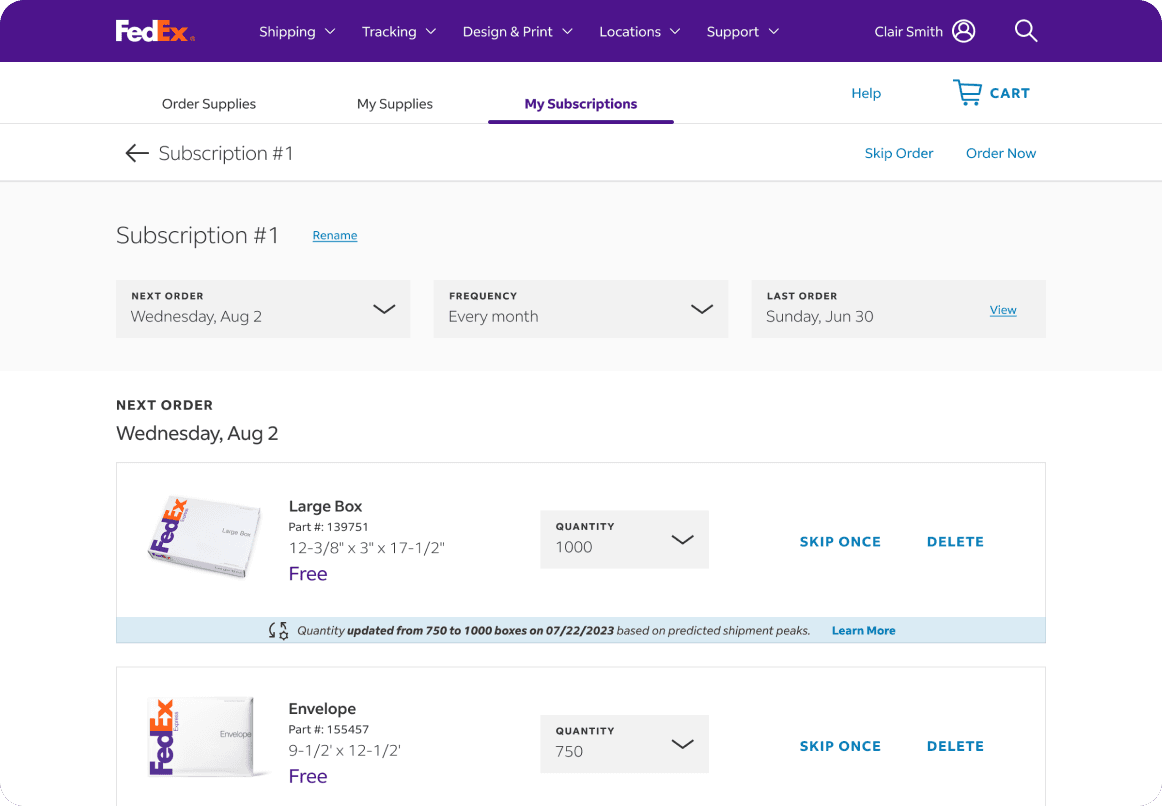
Subscription #1 view. Large Box quantity now 1000 with a callout strip beneath: "Quantity updated from 750 to 1000 boxes on 07/22/2023 based on predicted shipment peaks." Learn More link.
04 — Supplies utilization dashboard
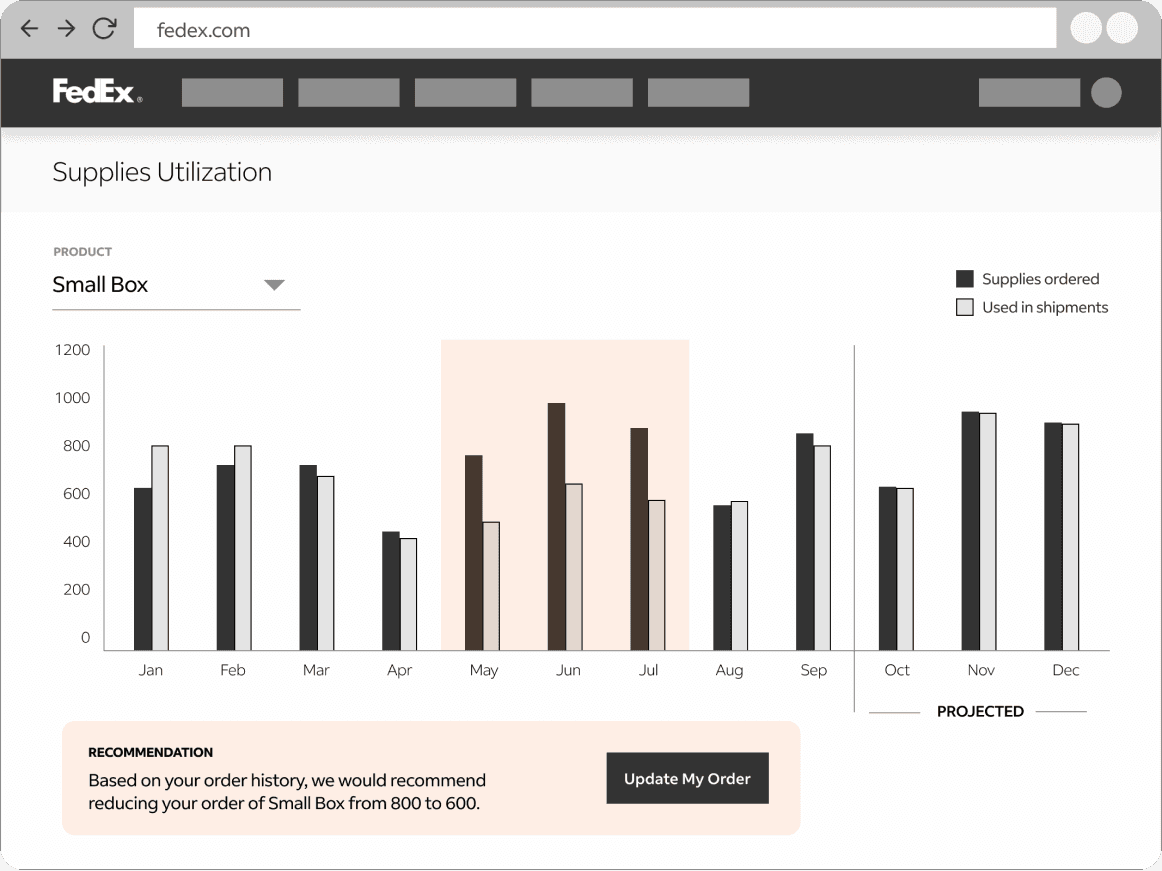
The strategic mirror, made the default. Ordered against used, where there hadn't been a view before.
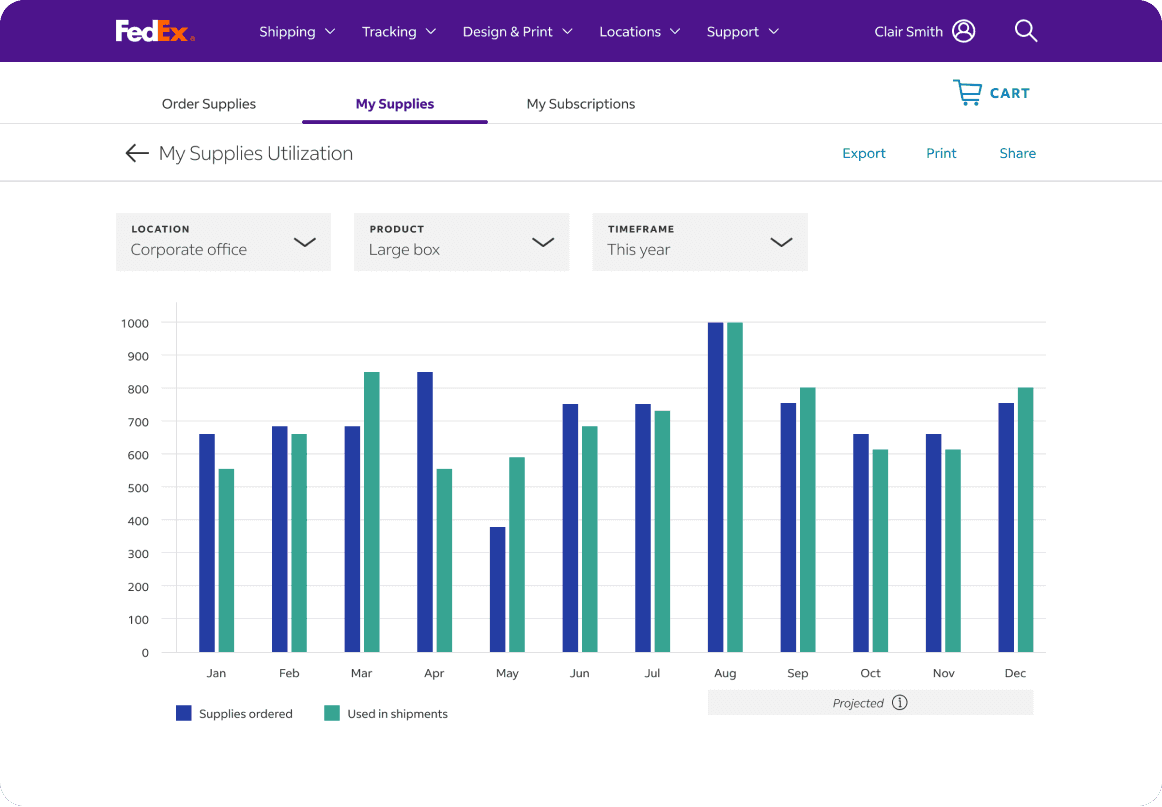
My Supplies tab. Bar chart of ordered versus actually used in shipments across the year, with projected portion for the remainder. Filters for location, product, and timeframe.
Sequence 2: Confidence at the friction point
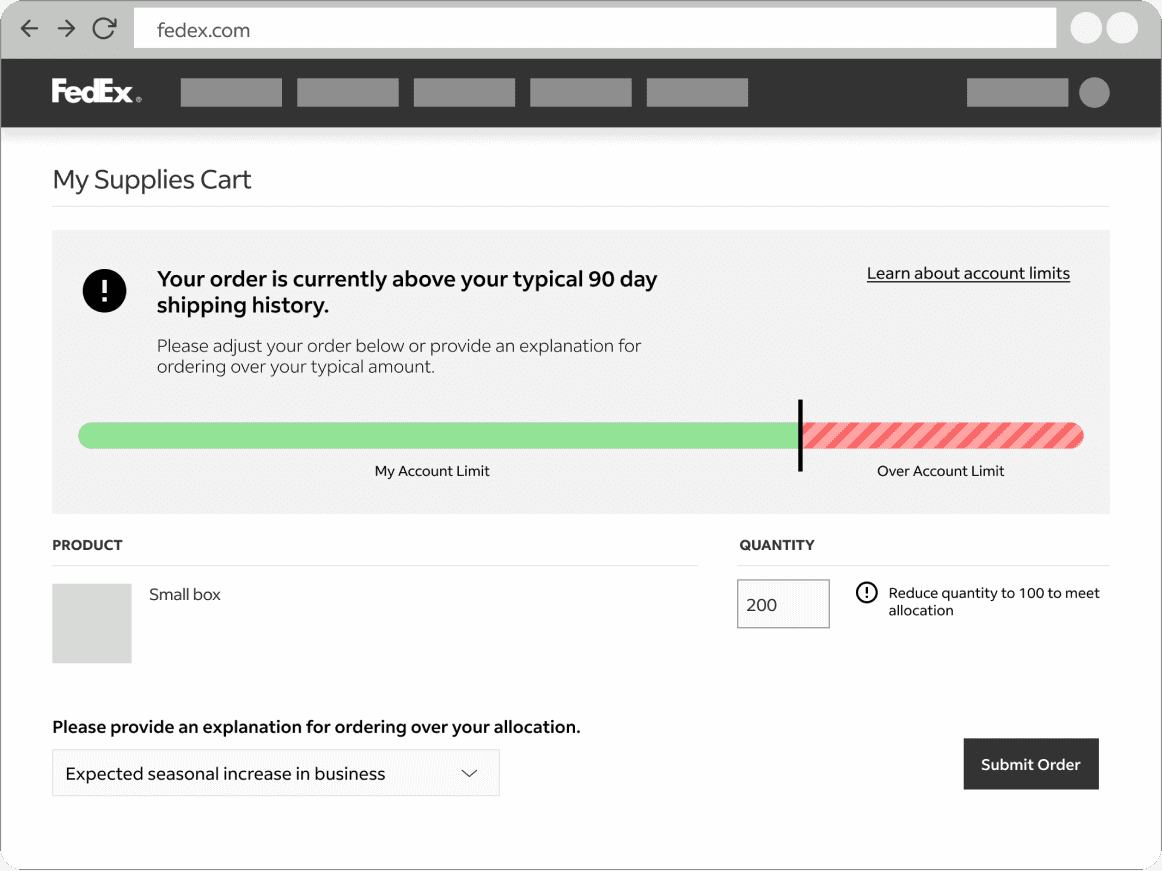
Account limits were one of the most expensive friction points in the existing experience. Customers hit them, didn't understand why, and lost time to escalation through customer service. The vision turned the limit moment into a conversation: explain what was happening, allow legitimate exceptions, and give the customer real options for what came next.
01 — Limit flagged in cart
No hard block. Context first, path forward second.
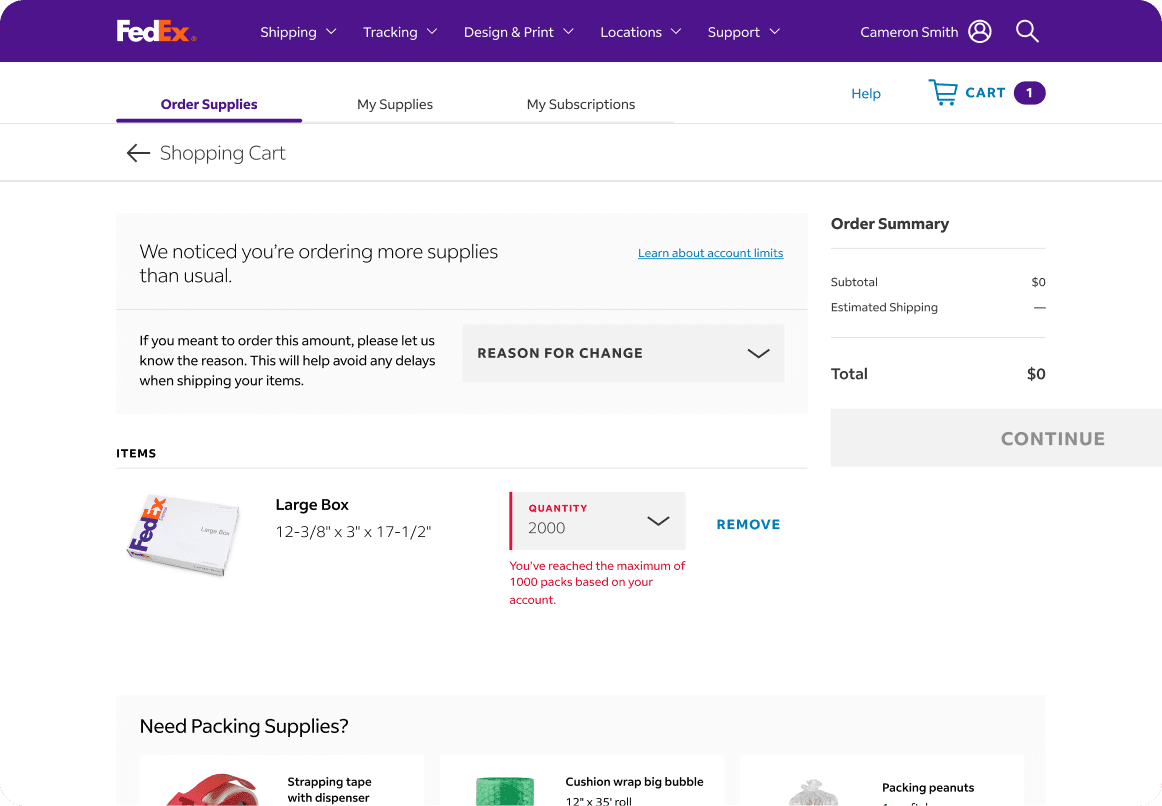
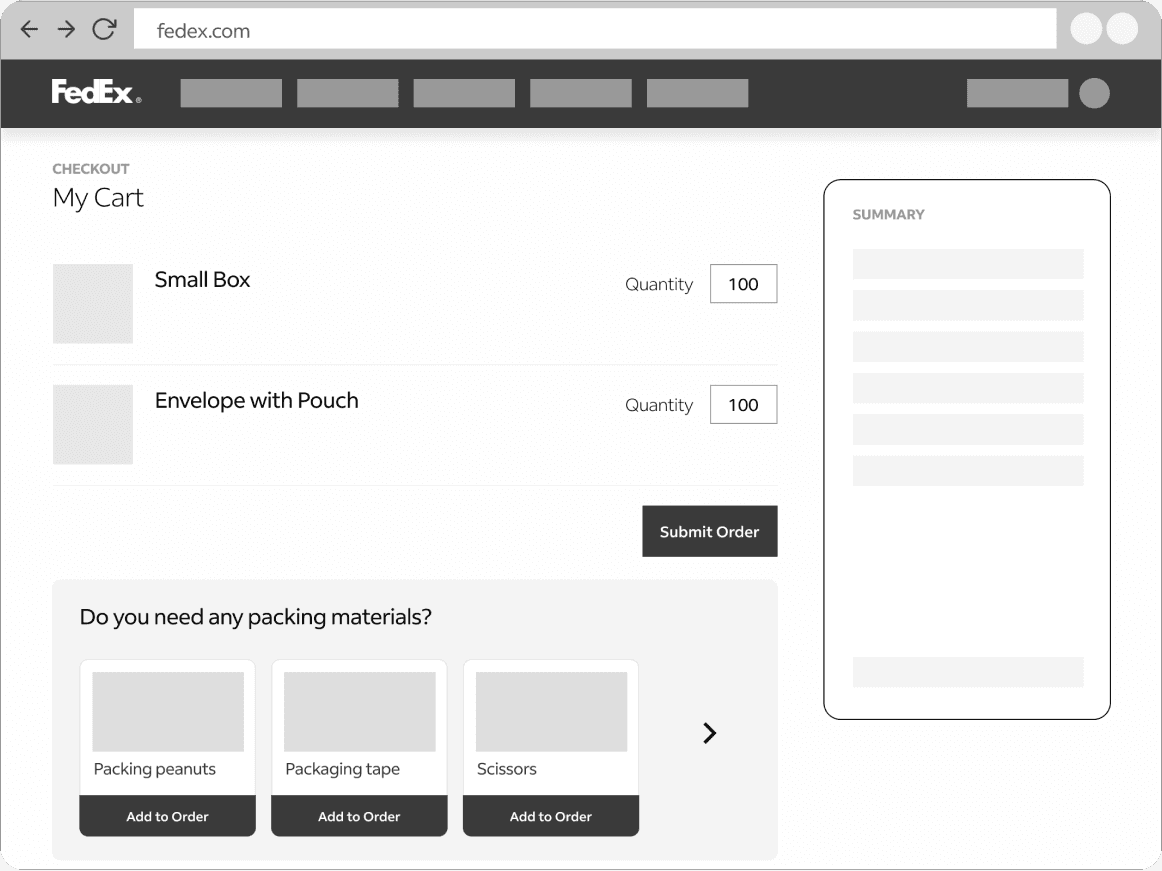
Shopping cart. Soft banner above the items: "We noticed you're ordering more supplies than usual." Reason for change dropdown alongside. Flagged line item with explanation: "You've reached the maximum of 1000 packs based on your account." Continue CTA disabled.
02 — Account limits explained
The rule is one click away and written in plain English.
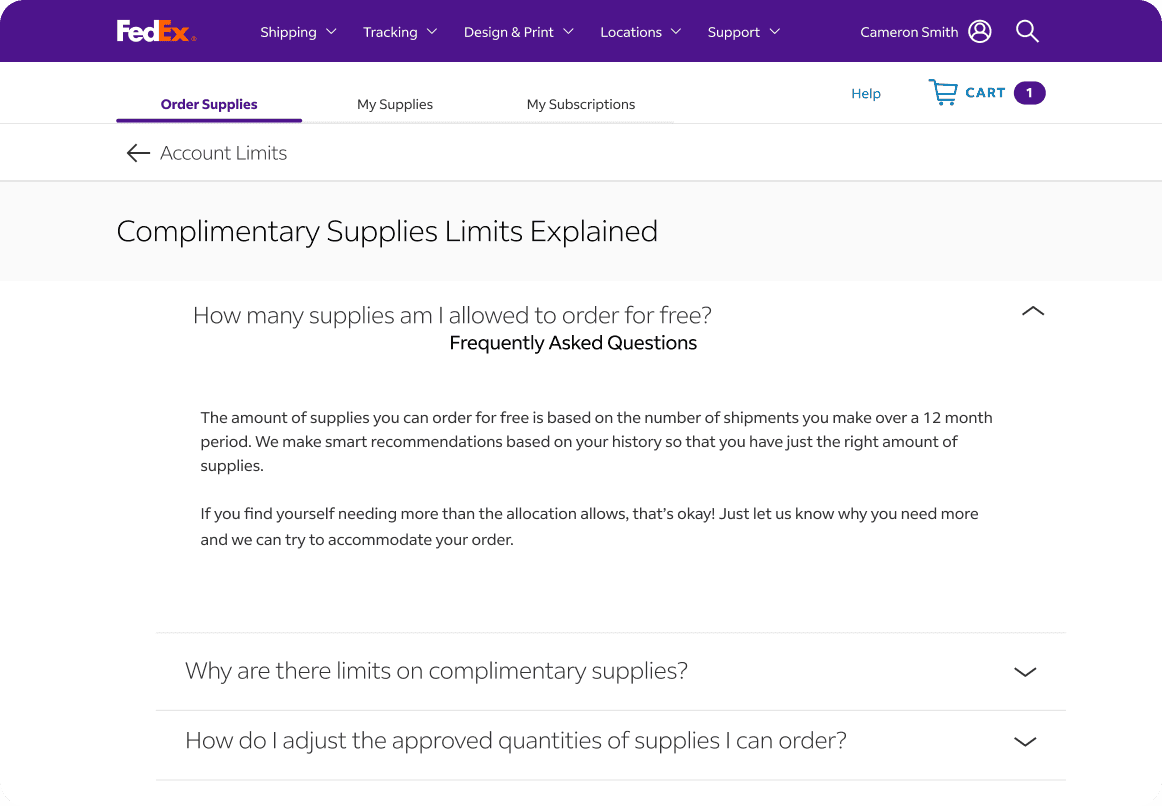
Account Limits page. Short FAQ titled "Complimentary Supplies Limits Explained." First question expanded in plain language: how the limit is calculated, why it exists, what to do if your situation doesn't fit.
03 — Reason selected, order unblocked
The customer proceeds without leaving the page. Automation with override.
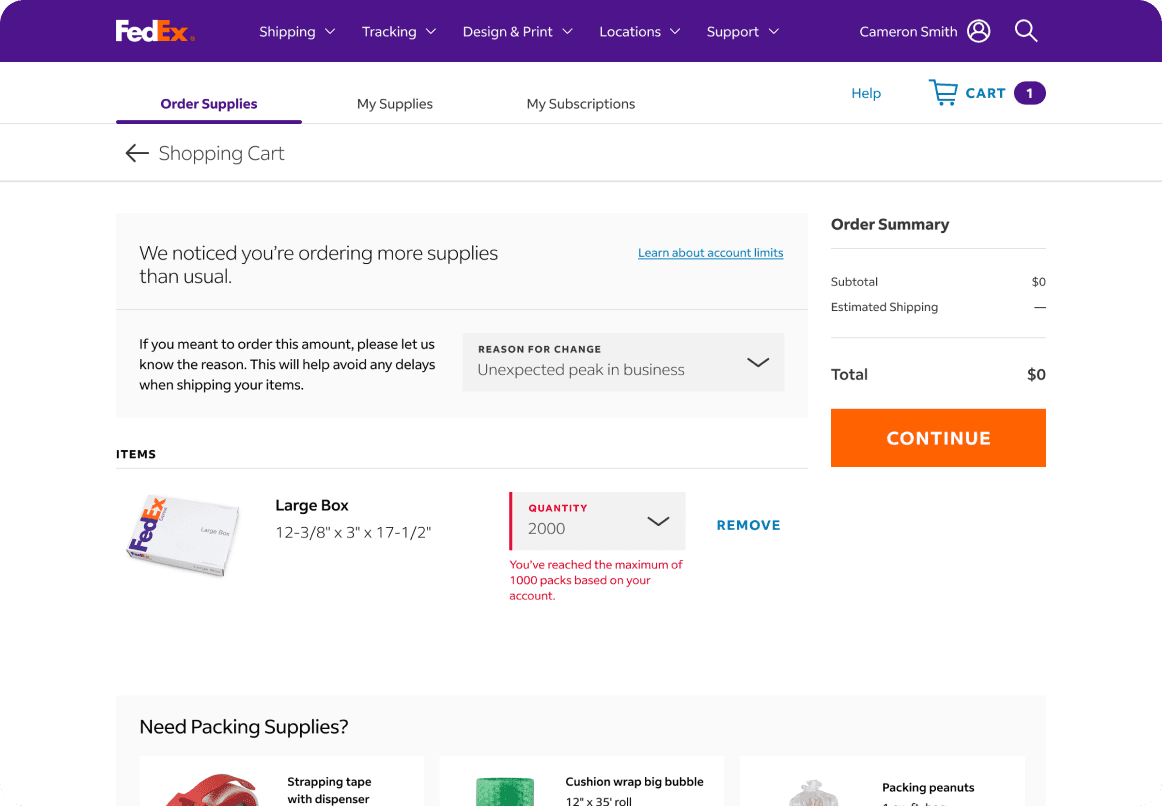
Same cart screen. "Unexpected peak in business" now selected in the dropdown. Continue CTA active. The over-limit warning remains visible on the line item.
04 — Self-service order management
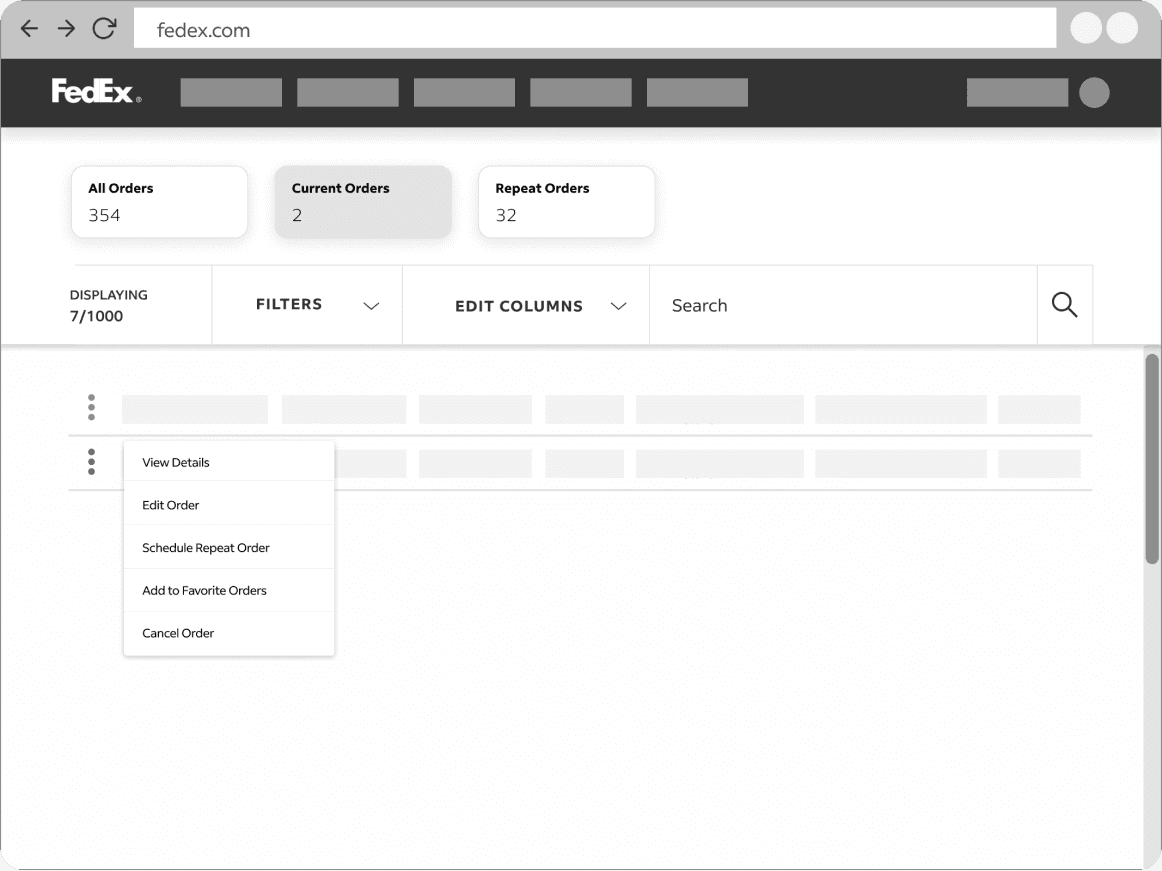
Track, edit, repeat, all without picking up the phone. Confidence comes from being in the loop, not out of it.
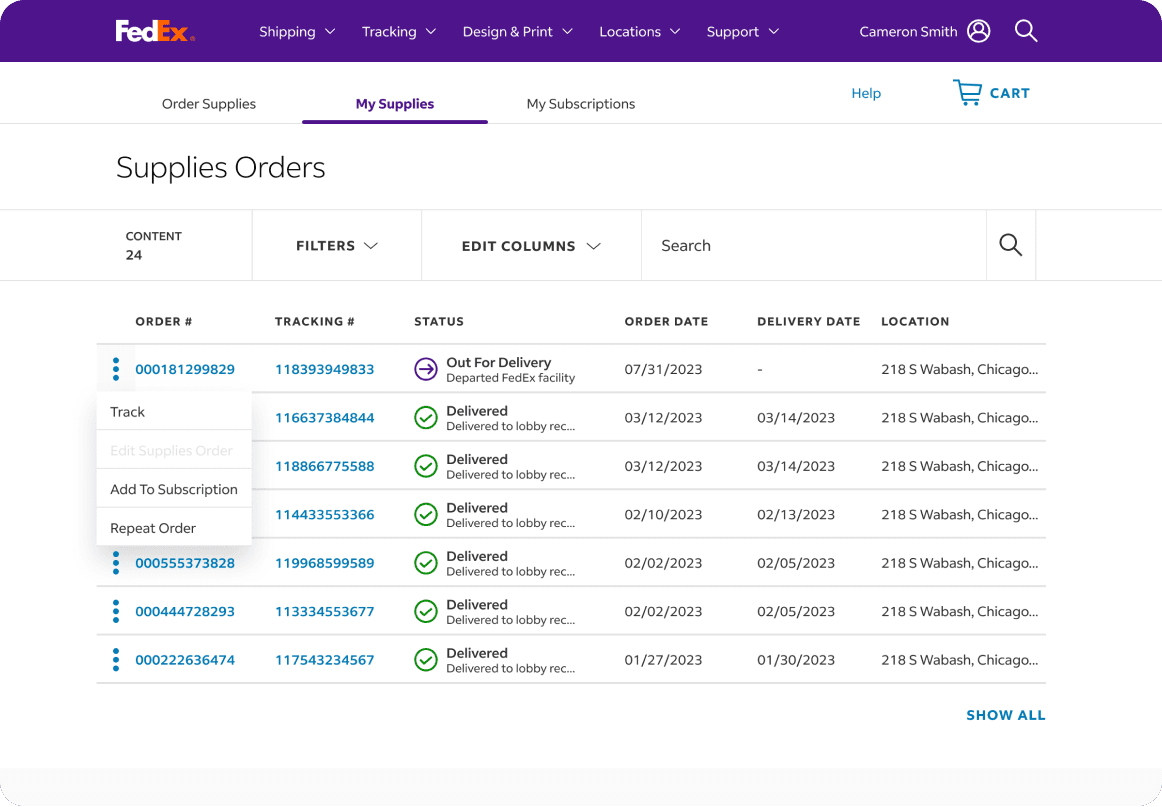
My Supplies tab, Supplies Orders table. Columns for Order #, Tracking #, Status (Out for Delivery, Delivered), Order Date, Delivery Date, Location. Row-level kebab menu with Track, Edit Supplies Order, Add To Subscription, Repeat Order.
Sequence 3: Guiding the whole shipping job
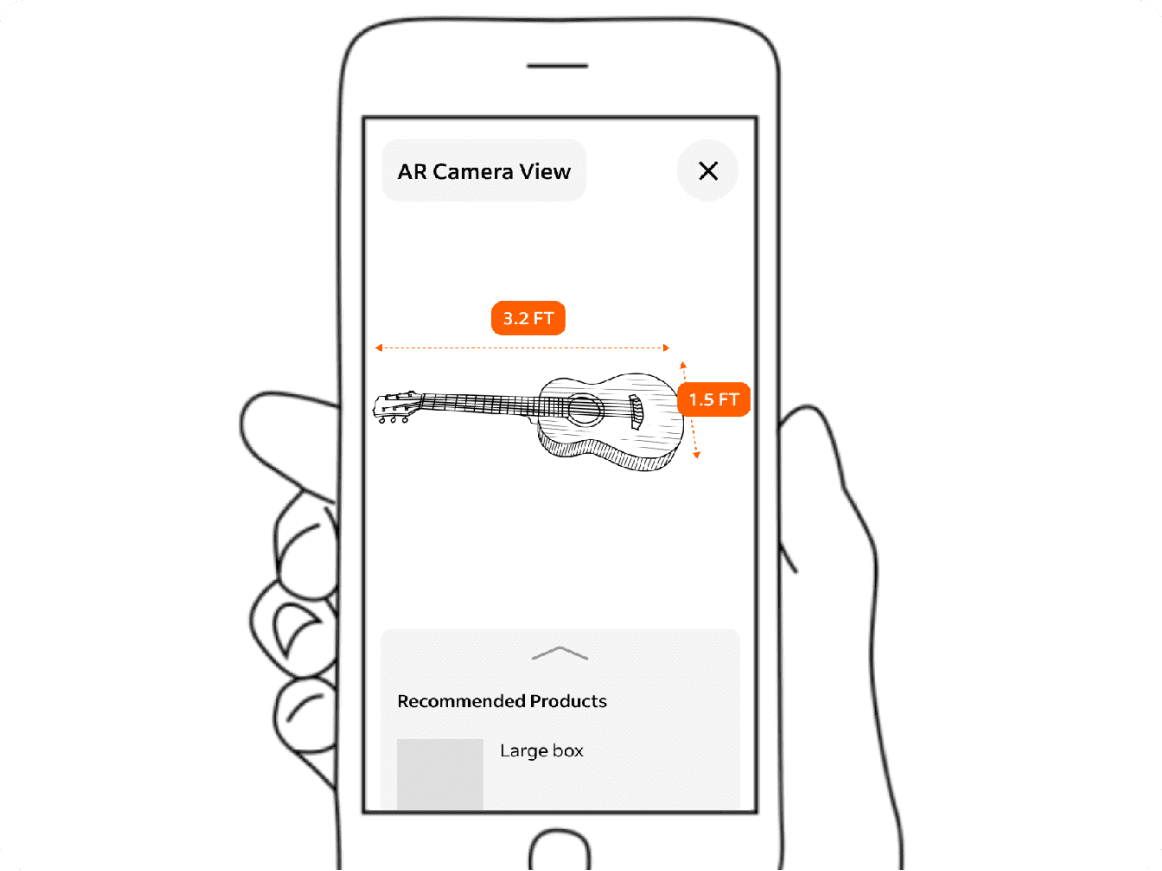
For customers with unusual or first-time supplies needs, a mobile AR tool let them measure a product with their phone camera and get the right box back. From there, the experience kept guiding: sustainable options surfaced first, related materials offered at checkout, and the shipment itself ready to start in the same flow.
01 — AR measure on mobile
The math problem of "which box" handled by the phone the customer already had.
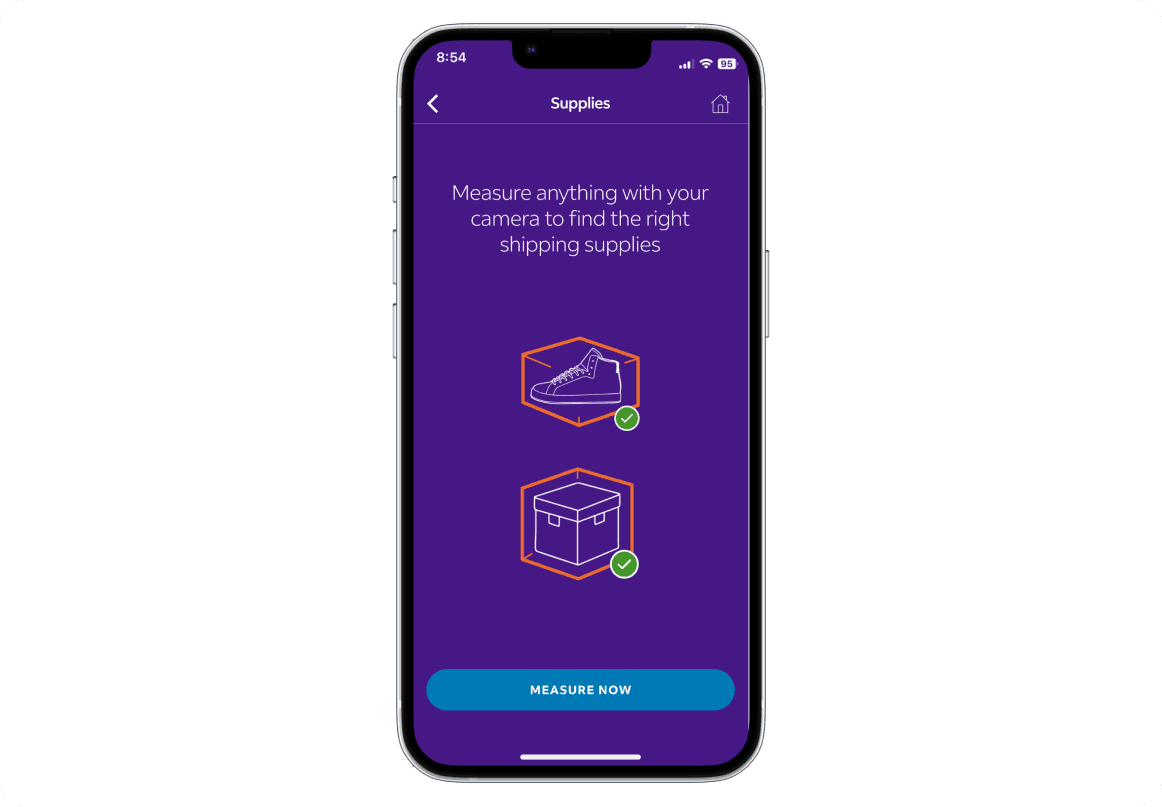
FedEx mobile app, Supplies view. Instructional message: "Measure anything with your camera to find the right shipping supplies." Two illustrative icons showing a product and a box. Measure Now CTA at the bottom.
02 — Sustainable option surfaced
The sustainable choice ranked first, not buried in a filter. Defaulting toward the principle, not just enabling it.
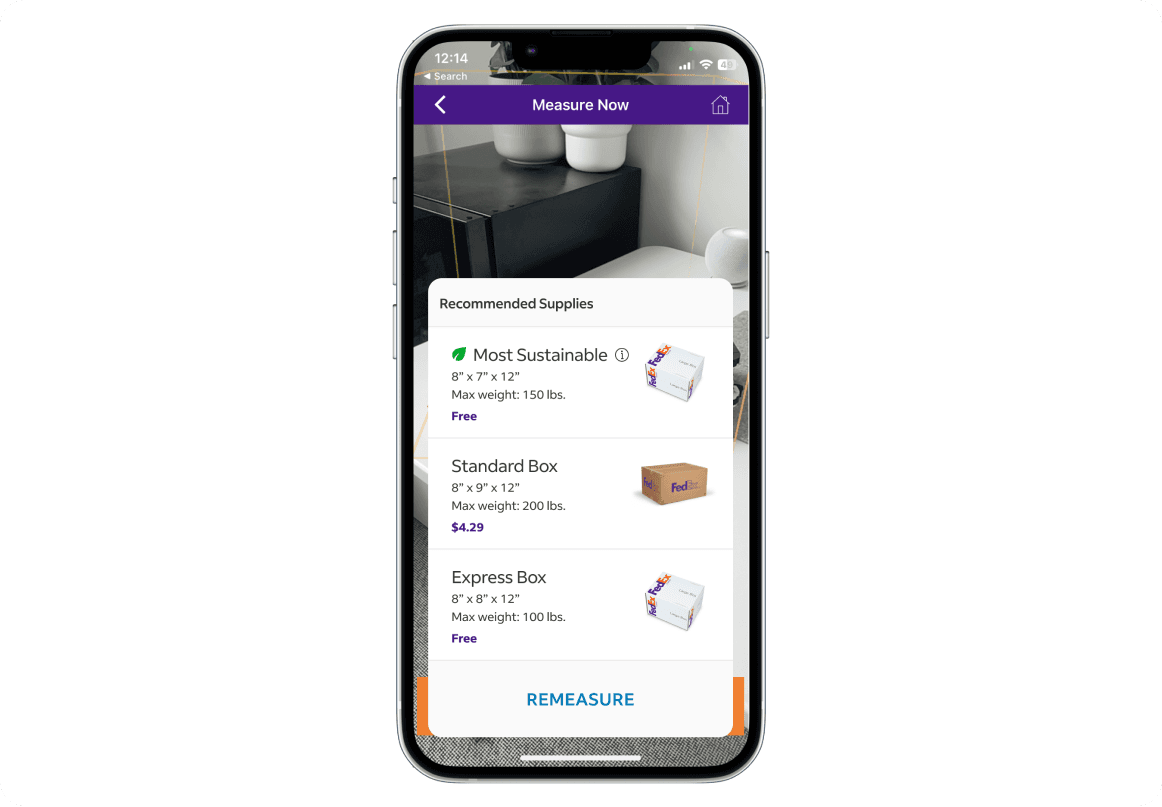
Camera view with a Recommended Supplies card overlaid. Most Sustainable option called out at the top with a leaf icon (Free), followed by Standard Box ($4.29) and Express Box (Free). Each with dimensions and weight limits.
03 — Packing materials inline
Related materials offered in the moment they're needed, not in a separate section.
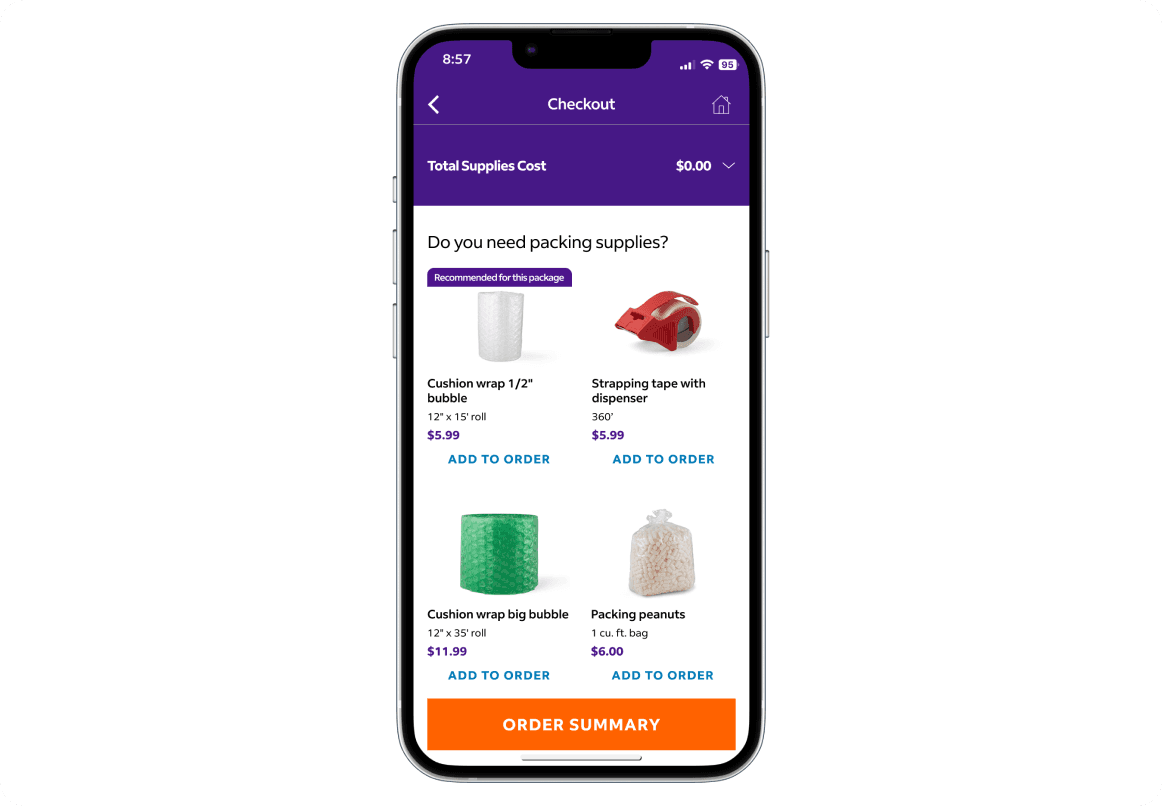
Mobile checkout. A "Do you need packing supplies?" prompt with four options in a grid: cushion wrap, strapping tape, larger cushion wrap, and packing peanuts. Each with a price and an Add to Order link.
04 — Supplies cart with shipment start
Buy the supplies and start the shipment in the same flow. Holistic shipping made literal.
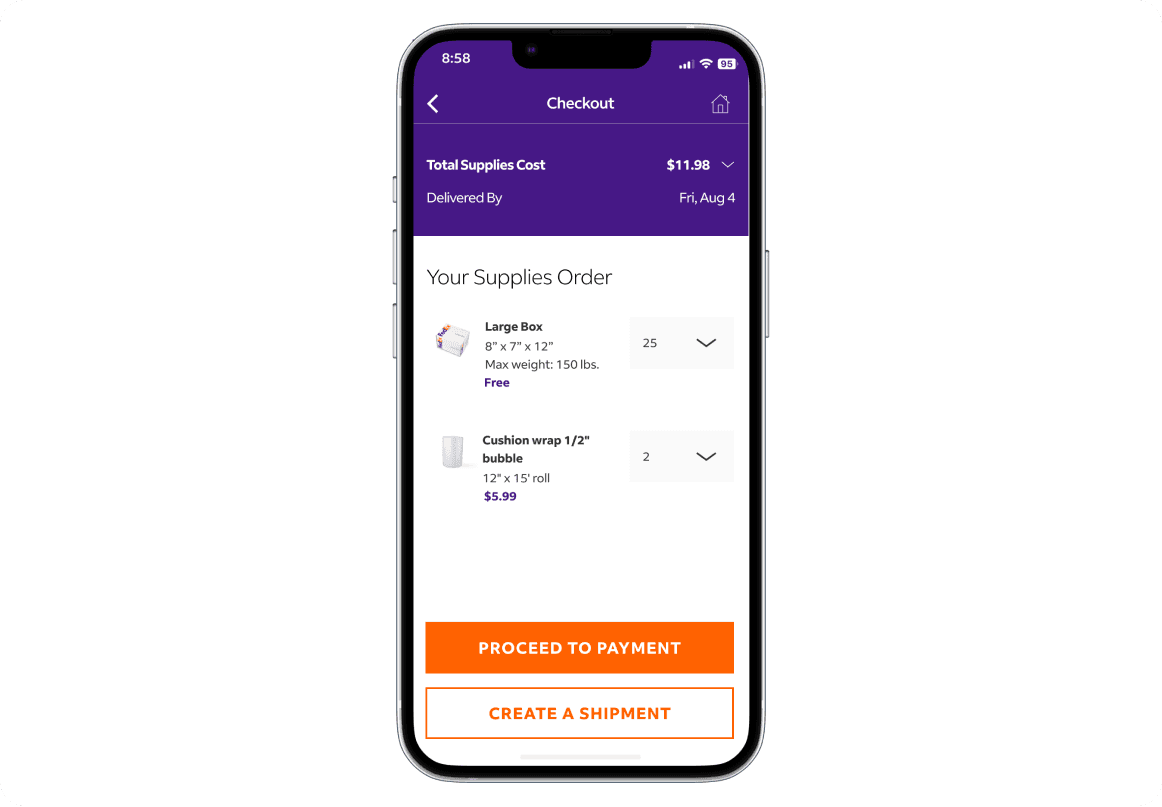
Mobile checkout cart. Supplies order summary with the box and cushion wrap selected. Two CTAs at the bottom: Proceed to Payment and Create a Shipment.
What it proved
Phase three closed with leadership buying the strategic direction. The mindset reframe became the through-line for the roadmap, the design directives shaped the scope of what got built first, and the agency rolled into a longer engagement on the build phase that I was not part of.
What the work proved was that a brief is rarely the real problem. FedEx asked for a redesign of an ordering experience and got back a reorientation of what supplies meant to their business. The redesign followed from the reframe, not the other way around.